
Finding Your Audience
Publication Not Required


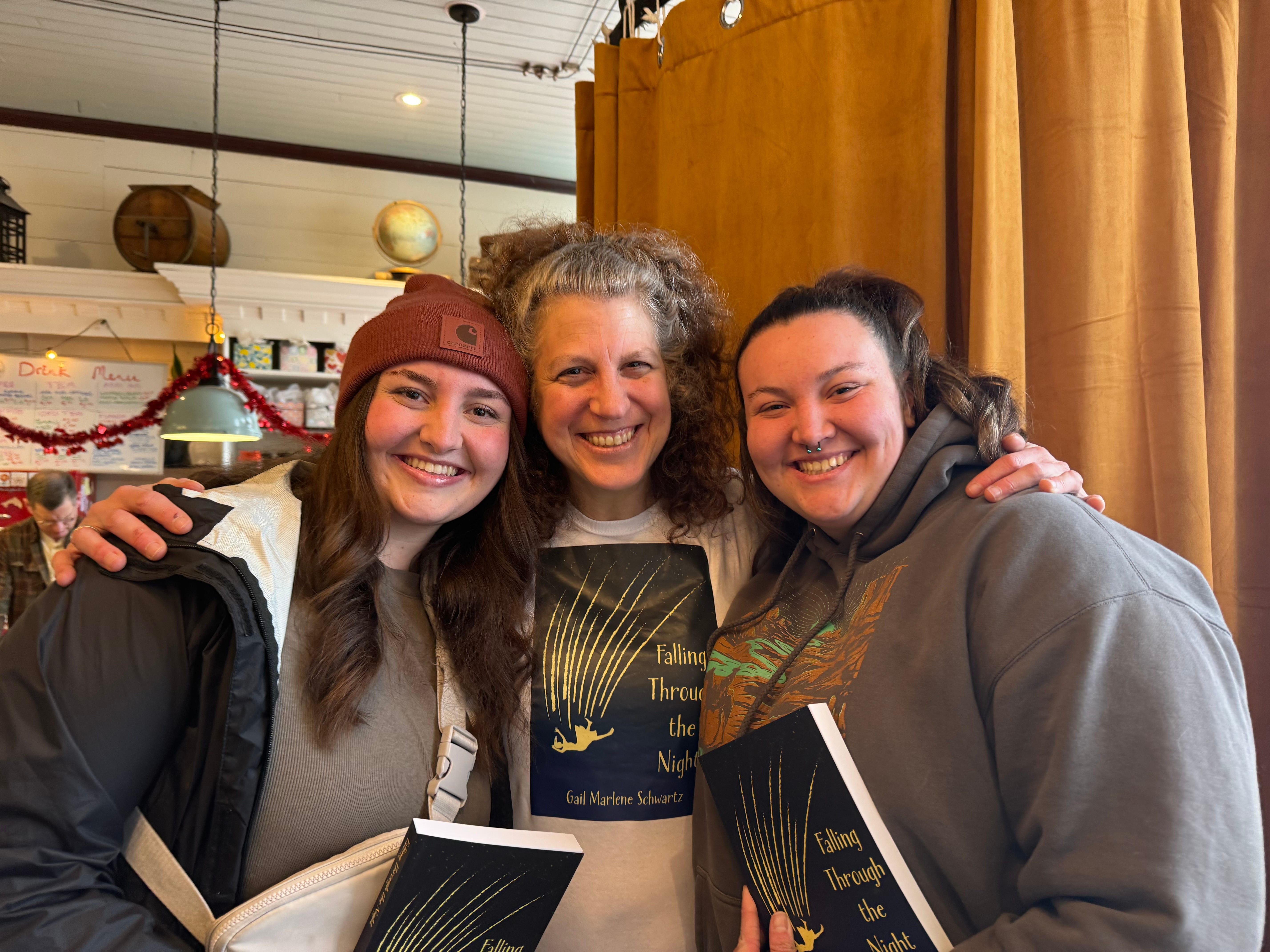
(Me with two favorite readers, former writing students Taran and Tatum Geoffrey-Kimball. photo by Erin Needham)
All writers who have worked hard on an unpublished book, story, or article know the meaning of heartbreak. A few weeks ago, my fabulous new friend Sarah Cook (on whom I have a wicked writer crush) published an essay that offers a wonderful perspective on this topic. The tagline is, “A love letter for when the work feels invisible,” and in it she talks about learning to value our writing practice in and of itself, slowly and deliberately shifting the focus toward self and away from externals like publication. Here’s the crux: “It is the act of making that enriches your life—not the reception of your output.” This is a beautiful and encouraging piece that every unfamous writer should see. I’ve read and reread it several times since she published it last month, and I’m sure I’ll go back to it again.
Having run the journal Hotch Potch Literature and Art for five years, I know that many of us, including brilliant and important writers, are in this position. Our work does not circulate widely because we, like most writers, aren’t famous and don’t have large platforms. It can be disheartening when we put so much our ourselves into work that remains unseen in the metaphorical or literal drawer. I hate that this reality can feel like an indictment of our writing. Chance and circumstance seem to be the most important ingredients in a career that goes viral; most simply don’t.
Sarah’s piece got me thinking. A lot. While I agree that the act of creation is important, and that we must always honor it, I also know that I bring a specific need to my writing practice: the need to be read. What drives me to write is the desire to communicate, first with myself but then, more importantly, with another human. For me, this means I won’t feel satisfied with writing a piece if someone else doesn’t read it.
What I don’t believe is that this means I have to publish or that my work needs to be seen by many people for me to feel satisfied and successful. Now, I happen to be in the unique position of having published six books. But the number of people who have actually read those titles is astonishingly small. Any businessperson would call my career as an author an abject failure, and if they are basing their assessment on the numbers, they would be correct.
But I have a different perspective because the numbers are not my metric. My measure of success is having readers who find meaning in my work. Period. Sometimes this means publication on a small scale, and sometimes this means being read by friends. But I do have readers now, and I feel successful.
Because of being able to articulate that need, I am making radically different choices than I did earlier in my career. What I didn’t know before I started submitting is that there are simple and attainable practices outside of the regular publishing model for writers who have a strong need to be read. If you want to build structures into your writing life to ensure that people read your work, even if you’ve never published anything, you can totally do it, without ever submitting. What this means is that we have agency, far more than we think we do.
Here are a few concrete ways to make that happen. Obviously, this isn’t a complete list; please add your ideas in the comments.
1) Initiate an email or snail mail dialogue
Team up with a friend who likes to write and send one another missives. Using snail mail (if your postal service isn’t on strike like ours, ugh) is especially fun. Letters are fine, but you can send more literary pieces as well. Imagine receiving a short story, essay, or poem in the mail once a month from a friend whose style delights you. It’s thrilling.
A key component is making sure that you truly love your friend’s writing and they love yours. This doesn’t work if one or both people feel obligated. Obviously you won’t like everything they send, but basic compatibility in this way is a must. Also, talk about goals with your partner so you both know the kinds of responses you’re looking for (or no response if that’s what your hearts desire).
I’m currently in an email dialogue with a new friend from choir, and it’s one of the richest and most satisfying connections I’ve had in my writing life. The structure is simple: we write one another emails, but they span many topics and allow us to think on the page and explore together. We’ve also shared more formal pieces. There’s something about her reading presence that unlocks the muse and allows me to access the parts of my style that feel so quintessentially me. Not only are we deeply enjoying one another’s writing, but since we are new friends, it’s allowing us to get to become more intimately acquainted. Her style is deep, grounded, funny, curious, smart, caring, and extremely present. Reading her thrills me because not only do I love her style, but I also appreciate how she perceives the world, what she notices and what she thinks about. She frequently expresses how much fun she is having too. It’s a total win-win.
My partner and I also used to email one another when we were first dating. We had this structured game we played where each of us would ask a getting-to-know-you question, and then we’d each answer it. Two examples: “Share your three best and worst qualities” and “What are three of your all-time favorite bands and why do you love them?” The conversation was so stimulating that it often distracted me at work, which didn’t go over so well with my boss. Aside from that risk, there are no down sides. The thrill of writing for one person while also enjoying their work is a very particular and intimate pleasure.
2) Start a writing share group
My best friend participates in one. Members write to a prompt and then get together once a week for a meal and a workshop session. They read what they wrote during the week our loud and then they also write something else on the spot to a second prompt, which they also read out loud. They offer one another comments but not critiques. It’s totally supportive and fun; they learn because they’re engaged in the process, but it’s not an educational endeavor. Again, I recommend that if you decide to do this, you discuss what kinds of responses you’re looking for, if any (for example, “What did the text make you think of?” “What words grabbed your attention”? “What images struck you,” etc.). This type of group reminds me of authentic movement, where one person has a timed improvisational movement session and witnesses offer thoughts if the mover asks for them. The process can be very gratifying; it can absolutely meet a writer’s need to be read.
3) Tart up your utilitarian writing
There’s a lot of writing we do in our lives that’s practical. The best example of someone who decided to turn a task into a creative opportunity is my friend Felicia, another editor from Hotch Potch. Tasked with the minutes from our biweekly meetings, Felicia turned the dreary job into something that has become so wildly hilarious that I actually look forward to reading the document. This has accomplished two important things: one, it’s far more likely that the staff will actually read the damn things. And two, Felicia has a new audience for her humor writing, something that doesn’t show up in her long-form stories. Talk about win-win. Here are a few passages from a recent meeting, just because I am dying to share this with someone outside of the collective:
“Welcome: We skipped the niceties. We already know one another.
The numbers: ‘Downloads have tapered off a little,’ Marco reported. ‘Still, we have 2,500 verified downloads, which—doing math, Hotch Potch style—means we really have twice that many. More, even.’
Too bad Hotch Potch-style math doesn’t work for my checking account, each of us thought in italics. The thoughts soon faded, since we haven’t yet homogenized the way we treat quotes and interiority.
Schedule ‘Nothing to note,’ Marco said, with an air of airy nonchalance. ‘We’re on track. We’re a well-oiled Swiss machine,’ he added, unaware of Heather mentally transforming each Zoom participant into an android out of a Fritz Lang movie or a sinister, well-oiled dystopia.”
Obviously, you need to bear in mind appropriateness, but even within those limits, there’s a lot a strong writer can do to flex their muscles. Other types of pieces that you might decide to add some flair to are holiday cards, routine emails, work memos, to do lists, or even texts.
4) Join a writing community
...like Inked Voices (there are many others; this just happens to be mine). There are critique groups, accountability groups, prompt groups ... I’m betting if the community is flexible enough, you could start a group of your own if the point was just to read one another.
5) Start a Substack
Originally, before it got corporatized, Substack was the gritty and independent home for free-thinking writers interested in publishing long-form digital content. Although things have changed, those people are still there, and it’s a great place to expand. This idea can feel daunting to many writers. But if you give yourself a regular publishing schedule that’s reasonable, a defined audience you’re writing for, and a type of writing (like essays, poetry, short stories, or a serialized novel), the likelihood that you’ll attract a few readers grows. There’s certainly no guarantee that you’ll develop a readership, but if you interact with others who share your audience demographic by liking and commenting, you boost the odds. While I don’t have thousands of followers, I have 200 after about a year and a half, and this feels like plenty.
6) Start an online literary magazine
...like Hotch Potch Literature and Art (the journal I co-founded with friends during COVID). HP is moving into year five and just published our eighth issue. We had absolutely no idea what we were doing when we started (and boy did it show!), but we learned along the way. We now have over 1200 Instagram followers and generally get around 500 sets of eyes over each issue. Just make sure to involve an artist/designer to craft the publication’s look, a skill writers tend not to have and something very important for attracting an audience. Along with great community, the most rewarding thing about my journal experience is having a regular readership. Twice a year, I write two short stories, and twice a year, I people read them. It’s not fame and fortune, but it doesn’t need to be for me to feel satisfied and proud.
***
Something else to keep in mind when making decisions about your writing practice is the question of quantity. This has been a big deal to me because my books had low sales but very positive reviews. Here is a thought experiment that helped me a lot. Ask yourself, “How would my life change if 10 people read my book versus 100? Or 1,000?” When I thought about this, although I had a gut feeling that 1,000 was better, I couldn’t think of how my life would actually be different in any meaningful way. Royalties would be nominally better, but not enough to feel it in my budget, and I couldn’t come up with any other difference.
It’s only when the numbers start going to 10,000 or 50,000 that I imagined there might be a discernible change. I might, as a result, be invited for higher-status interviews or get solicited for other project work, something that could be interesting (and then again, that might not happen). The extra money might be enough to afford something I wouldn’t have been able to otherwise, although certainly not enough to quit my day job.
But what does it take to get to that level? Marketing work is hard and time consuming, and there are no guarantees. I recently read that the average number of copies sold per title in the US is 12 (no, that’s not a typo). My experience was better but not by much, and this exercise made me totally rethink how I want to spend my time, which is my most precious resource.
I’ve basically decided that promotion isn’t something I have much interest in, after the effort I made for my last two books. For the recently published collection of essays, I marketed for close to 20 hours a week for three months. I set up multiple national spots in mainstream media outlets, partner events with nonprofits, interviews on several podcasts, blurbs from several well-known authors, and we ended up with a straight 5-star review average on Goodreads.
Sales haven’t broken 150.
The year before, I hired a publicist for my adult novel, Falling Through the Night, for many thousands of dollars. That book won two national awards, and reader reviews have all been above 4 stars. I had a highly positive write-up in Kirkus, numerous other reviews on other media outlets, and a very positive reception overall.
Sales to date have been around 400.
On the other hand, I’ve had several incredible conversations with friends and acquaintances who have read the book. One friend sent an email that I read over and over when I feel down. It’s clear that what’s lacking in breadth is made up for in depth.
The kind of sustained dedication to self-promotion, for me, is not something I’m willing to do because it simply isn’t worth it; it doesn’t make any difference to my lived experience as a writer whose primary need is to be read. The difference between 10 people reading my book and 400 is negligible. I’ve tried, using both time and money, and whatever I’ve done hasn’t yielded anything close to a meaningful result. To dedicate even more time and energy to marketing than I already have is simply not how I want to spend the time I’m not working for money; I have other priorities. One writer I know spends 4-5 hours a day on Substack, reading others’ work and commenting in order to develop an audience for her book. I think she has 2,000 followers, which doesn’t feel significant when you play the numbers game. It just isn’t worth it to me on the off chance that my book might, if I’m lucky, break through.
Taking time to assess your needs as a writer is so important, and it’s not something many of us talk about. If you’re like me, and you need to be read, please know that you can cultivate an audience without publishing. Consider my suggestions, and if you have ones of your own, I’d love you to include them in the comments. Remember that your writing matters, and if having readers is important, you will find ones for whom your work has meaning. For me, dialogue with readers is one of my very favorite parts of being alive.
For those of you who enjoy Sarah Teresa Cook’s essay, please keep an eye out for my interview with her which I’ll be conducting this weekend. We’ll be talking about one of the most challenging aspects of being in relationship with other writers: the tension between support and honesty with regards to one another’s work, especially when the other’s writing doesn’t speak to us.
 | A guest post by
|
Love this perspective; how do you maintain that intrinsic focus when external pressures feel stong, your insights are truly invaluable.
THIS IS EVERYTHING. GAIL.